
209 lines
6.2 KiB
Markdown
209 lines
6.2 KiB
Markdown
# P17089 掷出重围 题解
|
||
|
||
## 题意分析
|
||
|
||
题目中有 $n$ 个球,每个球有两个属性:
|
||
|
||
- $w_i$:这个球被精准投掷后的初始落点。
|
||
- $x_i$:投掷这个球需要消耗的体力。
|
||
|
||
小 ζ 的总体力为 $s$,所以他不能随便把所有球都投出去,而是要从这些球中选择一部分,使得选中球的体力消耗总和不超过 $s$。
|
||
|
||
与普通背包不同,球的最终位置并不一定等于 $w_i$,如果一个球落在位置 $p$,而位置 $p$ 已经有球了,那么它会继续向前滚到 $p + 1, p + 2, \dots$,直到第一个没有球的位置。
|
||
|
||
因为小 ζ 可以任意决定投掷顺序,所以同一批被选择的球,不同投掷顺序可能会导致不同的最终位置分配。题目要求的是,在所有合法选择和投掷顺序中,使所有投出球的最终位置坐标之和最大。
|
||
|
||
## 10pts
|
||
|
||
仿照普通背包,设 $ans[i][j]$ 表示考虑前 $i$ 个球、体力不超过 $j$ 时,最终位置坐标和的最大值。
|
||
|
||
由于一个球落地后可能会继续向前滚,只记录最大和还不够,还需要知道当前方案已经占用了哪些位置。于是再使用一个 `set` 维护当前状态下已存在的球的位置:
|
||
|
||
```cpp
|
||
set<int> f[505][505];
|
||
long long ans[505][505];
|
||
```
|
||
|
||
其中 $f[i][j]$ 存储这个状态下所有球的最终停靠位置。
|
||
|
||
转移状态 $(i, j)$ 时,需要比较以下三种情况:
|
||
|
||
- 体力不超过 $j - 1$ 的最优方案,即状态 $(i, j - 1)$;
|
||
- 不选择第 $i$ 个球,即状态 $(i - 1, j)$;
|
||
- 选择第 $i$ 个球:若 $j \ge x_i$,从 $f[i - 1][j - x_i]$ 中的占用位置出发,找到从 $w_i$ 开始的第一个空位置 $tmp$。此时答案为 $ans[i - 1][j - x_i] + tmp$。
|
||
|
||
取三种情况中坐标和最大的方案,并同步保存其占用位置集合。
|
||
|
||
完整代码:
|
||
|
||
```cpp
|
||
#include <bits/stdc++.h>
|
||
using namespace std;
|
||
int n, s;
|
||
struct wx
|
||
{
|
||
int w, x;
|
||
inline const bool operator<(const wx a) const
|
||
{
|
||
return w > a.w;
|
||
}
|
||
} ball[505];
|
||
set<int> f[505][505]; // 表示前i个球、有j的体力最远可扔的球的落地位置
|
||
long long ans[505][505]; // 球位置的和(可能超出int)
|
||
int main()
|
||
{
|
||
scanf("%d %d", &n, &s);
|
||
for (int i = 1; i <= n; ++i)
|
||
scanf("%d", &ball[i].w);
|
||
for (int i = 1; i <= n; ++i)
|
||
scanf("%d", &ball[i].x);
|
||
sort(ball + 1, ball + n + 1);
|
||
for (int i = 1; i <= n; ++i)
|
||
{
|
||
for (int j = 1; j <= s; ++j)
|
||
{
|
||
if (ans[i][j - 1] > ans[i - 1][j])
|
||
{
|
||
ans[i][j] = ans[i][j - 1];
|
||
f[i][j] = f[i][j - 1];
|
||
}
|
||
else
|
||
{
|
||
ans[i][j] = ans[i - 1][j];
|
||
f[i][j] = f[i - 1][j];
|
||
}
|
||
if (j >= ball[i].x)
|
||
{
|
||
int tmp = ball[i].w;
|
||
for (int k : f[i - 1][j - ball[i].x])
|
||
{
|
||
if (k == tmp)
|
||
++tmp;
|
||
}
|
||
if (ans[i - 1][j - ball[i].x] + tmp > ans[i][j])
|
||
{
|
||
ans[i][j] = ans[i - 1][j - ball[i].x] + tmp;
|
||
f[i][j] = f[i - 1][j - ball[i].x];
|
||
f[i][j].insert(tmp);
|
||
}
|
||
}
|
||
}
|
||
}
|
||
printf("%lld\n", ans[n][s]);
|
||
return 0;
|
||
}
|
||
```
|
||
|
||
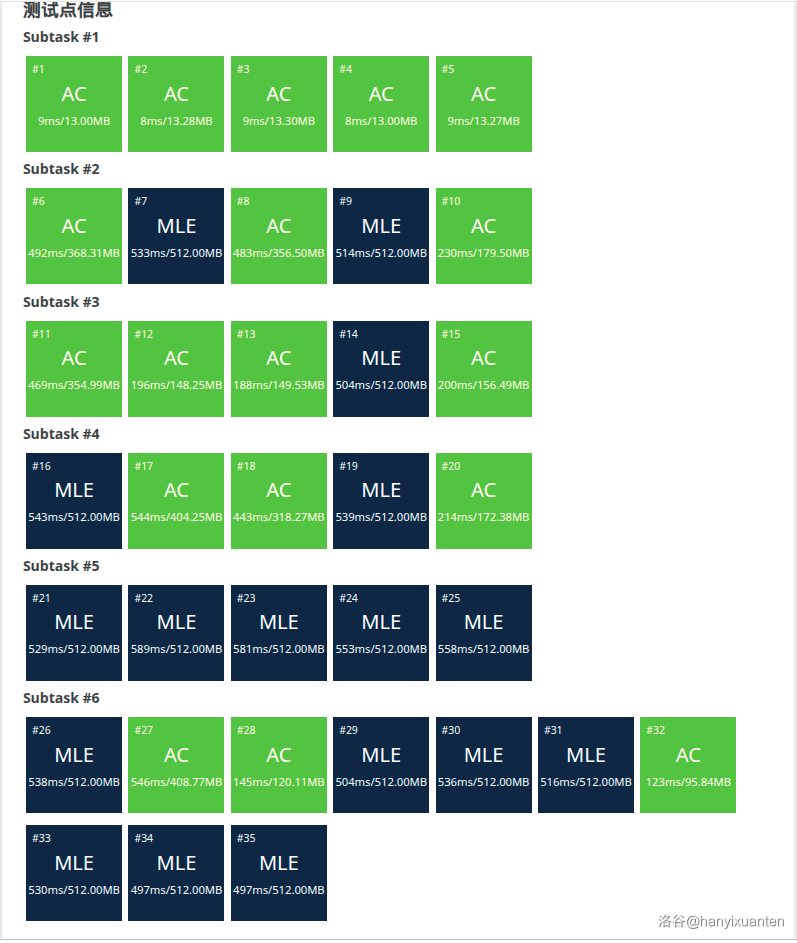
提交,喜提10ptsMLE
|
||
|
||
|
||
|
||
这个做法最大的问题是空间太大。
|
||
|
||
$n, s \le 500$,二维状态有大约 $500 \times 500 = 250000$ 个。每个状态还存一个 `set`,而每个 `set` 里面又可能有很多位置。
|
||
|
||
所以空间复杂度接近:
|
||
|
||
$$ O(n^2s) $$
|
||
|
||
而且 `set` 本身还有较大的常数开销,实际运行时非常容易内存爆炸。
|
||
|
||
## 优化
|
||
|
||
注意到背包转移中,第 $i$ 个球只会从上一轮状态转移过来,因此可以使用滚动数组。
|
||
|
||
把:
|
||
|
||
```cpp
|
||
set<int> f[505][505];
|
||
long long ans[505][505];
|
||
```
|
||
|
||
改成:
|
||
|
||
```cpp
|
||
set<int> f[505];
|
||
long long ans[505];
|
||
```
|
||
|
||
其中 $f[j]$ 表示当前处理到某个球时,体力不超过 $j$ 的最优方案所占用的位置集合。
|
||
|
||
选择当前球时,需要倒序枚举体力:
|
||
|
||
```cpp
|
||
for (int j = s; j >= ball[i].x; --j)
|
||
```
|
||
|
||
这样可以保证每个球只被选一次。
|
||
|
||
## 最终思路
|
||
|
||
对于每个球,倒序枚举体力 $j$:
|
||
|
||
1. 从状态 $j - x_i$ 转移过来。
|
||
2. 在该状态的占用位置集合中,从 $w_i$ 开始找第一个空位置 $tmp$。
|
||
3. 如果选择当前球后答案更优,就更新 $ans[j]$ 和 $f[j]$。
|
||
|
||
每轮处理完一个球后,再由小到大枚举 $j = 1 \dots s$,若 $ans[j - 1]$ 更优,则用 $ans[j - 1]$ 更新 $ans[j]$。
|
||
|
||
## 复杂度分析
|
||
|
||
滚动数组中有 $O(s)$ 个状态,每个状态保存一个最多含 $O(n)$ 个位置的 `set`,因此空间复杂度为 $O(ns)$。
|
||
|
||
每次转移需要遍历一个 `set` 寻找落点,并且在更新时复制该 `set`,两者最坏均为 $O(n)$。一共有 $O(ns)$ 次转移,因此时间复杂度为 $O(n^2 s)$。
|
||
|
||
## AC代码
|
||
|
||
```cpp
|
||
#include <bits/stdc++.h>
|
||
using namespace std;
|
||
int n, s;
|
||
struct wx
|
||
{
|
||
int w, x;
|
||
inline const bool operator<(const wx a) const
|
||
{
|
||
return w > a.w;
|
||
}
|
||
} ball[505];
|
||
set<int> f[505]; // 有j的体力时,当前最优方案中球的最终落点
|
||
long long ans[505]; // 有j的体力时,当前最优方案的坐标和
|
||
int main()
|
||
{
|
||
scanf("%d %d", &n, &s);
|
||
for (int i = 1; i <= n; ++i)
|
||
scanf("%d", &ball[i].w);
|
||
for (int i = 1; i <= n; ++i)
|
||
scanf("%d", &ball[i].x);
|
||
sort(ball + 1, ball + n + 1);
|
||
for (int i = 1; i <= n; ++i)
|
||
{
|
||
for (int j = s; j >= ball[i].x; --j)
|
||
{
|
||
int tmp = ball[i].w;
|
||
for (int k : f[j - ball[i].x])
|
||
{
|
||
if (k == tmp)
|
||
++tmp;
|
||
}
|
||
if (ans[j - ball[i].x] + tmp > ans[j])
|
||
{
|
||
ans[j] = ans[j - ball[i].x] + tmp;
|
||
f[j] = f[j - ball[i].x];
|
||
f[j].insert(tmp);
|
||
}
|
||
}
|
||
for (int j = 1; j <= s; ++j)
|
||
{
|
||
if (ans[j - 1] > ans[j])
|
||
{
|
||
ans[j] = ans[j - 1];
|
||
f[j] = f[j - 1];
|
||
}
|
||
}
|
||
}
|
||
printf("%lld\n", ans[s]);
|
||
return 0;
|
||
}
|
||
```
|